
KBIS® 2026 Signals a Structural Shift: From Product Marketing to Workflow Marketing
Every year, KBIS® produces its share of spectacle — bold finishes, expressive hardware, dramatic booth architecture, sculptural plumbing fixtures designed to stop traffic.
And yes, that energy was present again this year. Independent coverage from House Beautiful and Interior Design highlighted glowing tubs, art-inspired towel warmers, vivid hardware finishes, and expressive surface materials. Visual drama remains part of the language of kitchen and bath.
But when you step back from the spectacle — and look across award winners, exhibitor messaging, brand partnerships, and the tone of post-show commentary — a quieter, more consequential pattern emerges.
KBIS 2026 wasn’t primarily about bigger statements.
It was about fewer mistakes.
And in today’s market, that distinction is not aesthetic. It is economic.
What “Fewer Mistakes” Really Means
This is not about minimalism. It is about risk.
In the current construction environment — defined by labor constraints, pricing volatility, compressed timelines, and thinner margins — mistakes are no longer absorbable.
They show up as:
- Specification mismatches
- Finish inconsistencies under real-world lighting
- Installation misinterpretations
- Trade coordination breakdowns
- Technology integration conflicts
- Warranty callbacks
- Reputation erosion
A single error — a mismatched finish, a misunderstood tolerance, a system that doesn’t integrate cleanly — can eliminate profit on an entire phase of work.
In expansion cycles, performance gains matter most.
In contraction cycles, error reduction matters more.
Viewed through that lens, the most interesting signals coming out of KBIS 2026 point toward one unifying objective:
Reduce friction. Reduce interpretation. Reduce risk.
Coordination as Strategy, Not Styling
One of the clearest examples was cross-category coordination.
When Benjamin Moore partnered with Modern Matter to release cabinet hardware in the exact shade of its 2026 Color of the Year, Silhouette, the move went beyond visual alignment.
Historically, a Color of the Year is inspirational — a palette cue for designers and homeowners.
By extending that color into manufactured hardware with exact tolerances, paint moved from mood board to material system.
That shift reduces interpretive risk:
- No approximating finishes under jobsite lighting
- No custom powder coating to “get close”
- No field substitutions when tones clash
- No finger-pointing between painter and cabinet installer
Interpretation is where errors creep in. Pre-alignment removes interpretation.
But the deeper implication may land squarely on cabinet manufacturers.
If paint and hardware are coordinating intentionally, cabinetry cannot remain passive infrastructure. Cabinet brands may increasingly be expected to:
- Align finish libraries with dominant paint palettes
- Offer compatible sheen levels and undertones
- Coordinate metal accents within shared color ecosystems
- Integrate into cross-brand specification platforms
The competitive frame begins to shift.
It is no longer paint vs. paint.
Or hardware vs. hardware.
It becomes ecosystem vs. ecosystem.
Builders may increasingly ask:
“Which brands work together cleanly?”
That question changes everything.
Because clean coordination reduces change orders.
Reduces field debate.
Reduces callbacks.
In a margin-sensitive market, that has monetary value.
Proof Over Promise: Visible Engineering as Risk Mitigation

The same logic surfaced in how products were presented.
Instead of relying solely on spec sheets and taglines, several brands made engineering visible.
Whirlpool demonstrated UV sanitation technology live, allowing attendees to observe bacteria reduction rather than read about it.
LG Electronics showcased deconstructed appliance systems — exposing internal mechanics to reinforce durability and efficiency claims.
TOTO continued its use of transparent toilet models to reveal water flow geometry and flushing mechanics.
Even integrated charging systems from FreePower were embedded into working surfaces so that integration could be experienced rather than imagined.
These were not theatrical gestures.
They were credibility compressions.
When installers and specifiers can see:
- How airflow moves
- How water circulates
- Where tolerances sit
- How integration occurs
They are less likely to misinterpret performance requirements.
And guesswork is where mistakes begin.
Visible engineering reduces uncertainty before installation ever begins.
Transparency becomes strategy.
Incremental Innovation Over Disruption
Technology was present throughout the show — but the tone has changed.
Instead of sweeping disruption narratives, the most compelling applications were incremental.
KitchenAid earned Best in Show for a Smart Double Wall Oven with Live Look-In. Cooking did not change. The workflow improved. Fewer unnecessary door openings. Fewer heat losses. Fewer overcooked meals.
Health integrations from Kohler layered passive monitoring into fixtures already embedded in daily routines — without requiring entirely new behavior systems.
Efficiency gains from LG or sanitation refinements from Whirlpool enhanced existing habits rather than replacing them.
Same behavior.
Better outcome.
Lower friction.
In a cautious market, incremental innovation scales more easily because it avoids introducing complexity.
And complexity is risk.
The lesson is subtle but clear:
The safest innovation is the one that improves what already works.
Drama, But Disciplined
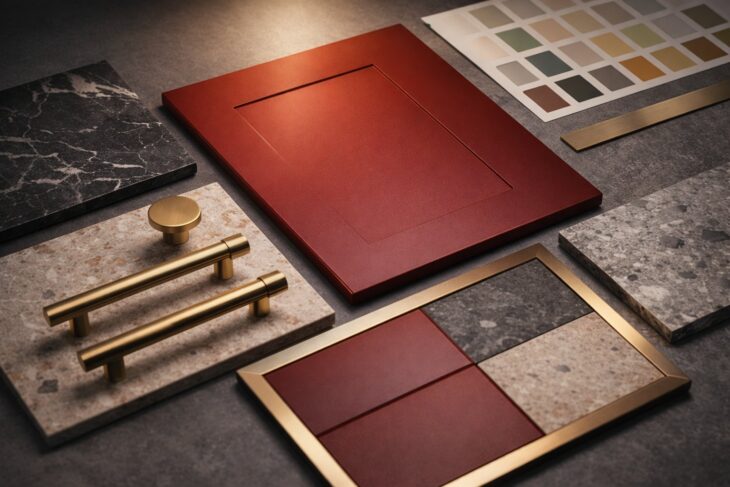 Expressive finishes and bold design moments were visible across the show floor — confirmed by independent coverage highlighting sculptural bath forms, art-driven hardware, and vibrant surface materials.
But even these dramatic moments felt curated rather than excessive.
Visual emphasis appeared where it added identity — not instability.
That restraint reflects economic reality. In a period shaped by tariff uncertainty and cautious consumer demand, refinement signals confidence. Overextension signals risk.
Theatrics weren’t gone.
They were intentional.
The Larger Recalibration
For decades, kitchen and bath marketing revolved around product superiority.
Better hinge.
Quieter motor.
Stronger finish.
Smarter control panel.
Features won arguments. Spec sheets closed deals.
That model works when growth absorbs inefficiency.
This is not that cycle.
Margins are thinner.
Labor is tighter.
Schedules are compressed.
Liability is heightened.
In this environment, a product that performs 5% better does not matter if it introduces coordination friction.
Superiority shifts from the object to the system.
And that is the structural shift signaled at KBIS 2026.
Manufacturers are moving from product marketing to workflow marketing.
The value proposition is no longer simply:
“Our product performs better.”
It is increasingly:
“Your process works better with us.”
Fewer handoffs.
Fewer mismatches.
Fewer surprises.
Fewer callbacks.
More predictability.
The product becomes less the hero.
The process becomes the advantage.
Why This Matters
 When the margin for error disappears, reliability becomes more valuable than novelty.
Reducing decision fatigue reduces error.
Reducing interpretation reduces rework.
Reducing complexity reduces liability.
In that environment, coordination compounds.
Brands that integrate across categories gain gravity.
Brands that simplify workflows gain preference.
Brands that eliminate ambiguity gain loyalty.
KBIS 2026 may not be remembered for one singular breakthrough product.
It may be remembered as the moment the industry quietly recalibrated its center of gravity — away from spectacle and toward system stability.
And in a market where the margin for error has disappeared, the brands that simplify the process — not just polish the product — will define the next cycle.
Did see something? Say something! Let us hear from you! And thank you for reading.